
Several factors affect plant growth, such as temperature, light, water, nutrient elements, etc., this article is about some knowledge of temperature.
Definitions:
Benchmark temperature: The lowest temperature at which a plant undergoes photosynthesis, below which the plant ceases to grow. Each plant is different, usually 5-10 ℃.
Optimum temperature: The highest temperature of photosynthesis rate of plants. Decreases with the maturity of plants.
ADT(Average Daytime Temperature):
ADT= (DT *DH+NT *NH)/24,
DT = Daytime Temperature, DH = Daytime Hours,
NT = Night Temperature, NH = Night Hours.
Accumulated Temperature: The product of temperature and duration perceived by a plant, unit is ℃ h.
DIF(Diurnal Temperature Fluctuation):Used to indicate the temperature difference between day and night,DIF=DT*DH-NT*NH
The relationship between plant growth and temperature
1.The Response Curve of Plants to Temperature
The reaction curve of plant growth rate with temperature is actually the reaction curve of enzyme and temperature. The plant itself is a vessel of chemical reaction. The reaction rate depends on the activity of enzyme. Within a certain temperature range (approximately from the base point temperature to the optimum temperature), the activity of enzymes is positively correlated with temperature and linearly correlated until the optimum temperature is reached. If the activity of enzymes decreases beyond this temperature, the growth of plants will also be affected.

Response Curves of Plants to Temperature
In a certain temperature range, temperature change has little effect on plant photosynthesis, but when the temperature is low, the rate of photosynthetic products transported and transformed becomes slower, so the growth of plants is slow.
2.Daily average temperature, Accumulated temperature, DIF
The speed of plant growth can be expressed by the increasing speed of the number of leaves. Within the linear range, the higher the average temperature, the faster the growth rate of plants.
Low temperature will reduce the growth rate of plants, but increasing temperature after experiencing low temperature will compensate for the loss of low temperature. Within the linear range, as long as the total accumulated temperature of the plant is the same, the growth rate of the plant will not be affected. The growth rate of the plant is the same under the conditions of 10 +25 of 10 A and 17.5 of 20 a. A is understood as the unit time.
There are two key parameters in the application of accumulated temperature theory: Bandwidth and Diviate Degree Hours. The former is understood as the value of environmental temperature deviating from the optimum growth temperature of plants, while the latter is the value of accumulated temperature deviating from the ideal accumulated temperature (the accumulated temperature needed to complete the growth at the optimum temperature), for example, the ideal accumulated temperature of a plant is a℃·h, and the actual accumulated temperature is b℃·h, whereas the degree Hours here is b-a. Within a certain Bandwidth, Diviate Degree Hours does not exceed a certain value, and the growth rate of plants is not affected. In the data, for example, when the temperature of roses does not exceed 5 ℃, the accumulated temperature difference within 150 ℃. h will not affect the yield of roses.
DIF affects plant morphology. When DIF decreases, plant internode length decreases. Therefore, DIF can be used to control plant height.
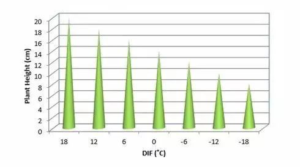
With DIF from positive to negative, plant height decreases gradually.
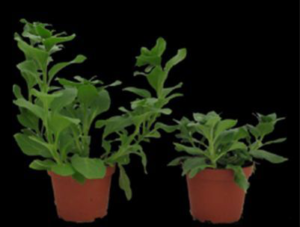
Comparison of plant height of Petunia hybrida under +DIF and-DIF
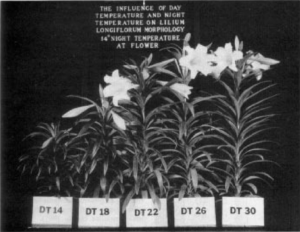
Under the same night temperature condition, plant height increased with the increase of daily temperature (DIF increased)
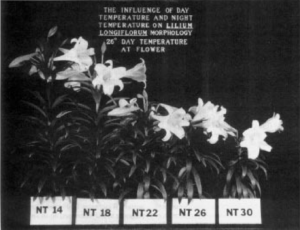
Under the same day temperature condition, plant height decreased (DIF decreased) with the increase of night temperature.
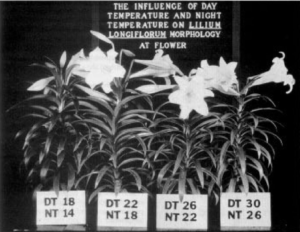
The same plant height under the same DIF without day and night temperature conditions.
Studies have shown that plant responses to DIF may be related to gibberellin, and not all plants can respond to DIF.
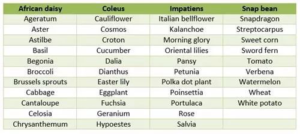
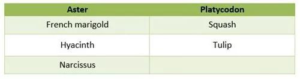
Plant species sensitive to DIF (top) and almost unresponsive (bottom)
The rate of stem elongation is not the same in a day: the rate of internode elongation is slower and slower in the daytime and faster in the night, so lowering the temperature of the first 2-3 hours in the daytime will reduce the internode length to the greatest extent, and the effect can be similar to that of lowering the temperature of the whole day.
Plants are most sensitive to DIF when photosynthesis is strongest and sunshine time is short.
Negative DIF has a negative effect on plants because it can change the direction of plant growth. Under positive DIF, plants will grow upright, while negative DIF, plants will tend to grow horizontally. In addition, negative DIF can reduce the leaf area of plants, thus affecting the photosynthesis of plants.


